
Tindale’s analysis is credible and alarming. Our normally phlegmatic colleague Aurelien sent it to us with a note: “Makes your hair stand on end…”
We alerted readers yesterday to the potential impact of anything beyond a short Strait of Hormuz on fertilizer and agriculture in our Iran war update yesterday. Tisdale argues that vastly more critical sectors will also be severely harmed. The neoliberal creation of overly-efficient supply chains that depend on petroleum inputs (Nassim Nicholas Taleb has long warned that highly efficient systems are fragile) means a marked oil/gas crunch will both cascade much faster than expected and have destabilizing synergies.
Please send this article to those in relevant positions, particularly market commentators, money managers, business journalists, and politicians, such as Congressional representatives and their staffers.
We strongly urge you to read Tindale’s assessment in full. Key parts of his executive summary:
The modern world order, having organized itself around efficiency, cost minimization, and logistical precision, has created a machinery of dependence so extreme that the interruption of one narrow corridor can propagate outward into a general crisis of civilization….
From this follows a chain whose logic is cumulative: fuel inflation becomes fertilizer inflation; fertilizer inflation becomes food inflation; food inflation becomes urban instability, sovereign subsidy exhaustion, and ultimately hunger. In this sequence, food shortages are not a secondary humanitarian issue. They are one of the central political outcomes of the crisis, because modern populations do not experience systemic breakdown first through grand strategy, but through unaffordable bread, intermittent power, empty pharmacies, and possibly the collapse of public order. A globalised Arab Spring.
In this framework, hyperinflation emerges as the social expression of real physical bottlenecks. When energy-importing states are forced to acquire dollarized fuel at any price, when currencies weaken, when fertilizer and transport costs reprice an entire harvest cycle, inflation ceases to be cyclical and becomes coercive.
It enters every household budget and every state ledger at once. The result is the destruction of planning itself: firms cannot quote, governments cannot subsidize, and populations can no longer calculate the future. Under such conditions, credit markets seize up, foreign-exchange reserves drain, sovereign spreads widen, and the boundary between economic crisis and political crisis disappears.
Modern technical systems amplify rather than dampen this disorder….
Thus, the closure of a maritime strait reaches, by entirely material means, into the server rack, the hospital network, the payment system, the electrical substation, and the defence-industrial base. The myth that digital civilization floats above heavy industry is, in this scenario, extinguished. Compute is shown to rest on copper, transformers, stable voltage, LNG, and ship…
The most immediate suffering falls on import-dependent and fiscally weak societies: blackouts, food insecurity, unemployment, debt default, regime stress, and mass unrest. Yet the advanced economies do not escape. They experience industrial contraction, infrastructure delays, AI and semiconductor bottlenecks, strategic stockpiling, and the permanent repricing of security over efficiency. What begins as a supply shock ends as a transformation of the political economy. States abandon the fiction of neutral markets and move toward command allocation, export controls, emergency powers, and militarized trade corridors. Market price gives way to strategic rationing. Globalization does not simply slow; it hardens into armed blocs.
The ultimate conclusion is grim : the terminal danger in this model is not one shortage, nor one recession, nor even one war-risk premium.
It is the transition from a globally integrated commercial order into a world system governed by scarcity, coercion, and administrative triage….
They are the normal operating features of a civilization that has discovered, too late, that its efficiency was built on concentrated fragility….
Such is the risk. The whole world will be compelled to support efforts to bring this situation under control immediately. China, the US, and Europe will have to work together.
The political cycle over the coming days and weeks is going to matter like never before.
Here are 10 likely and immediate crises
Polyester -> apparel…
Natural gas -> fertilizer -> food…
Sour crude / sulfur -> sulfuric acid -> copper…
Propylene -> polypropylene -> medical and packaging…
Salt + power -> chlorine / caustic soda -> water treatment…
Natural rubber + synthetic rubber -> tires -> freight…
Iron ore + metallurgical coal -> steel -> construction and machinery…
Bauxite + alumina + cheap power -> aluminum -> transport and packaging..
Soda ash + natural gas -> glass -> buildings, autos, solar….
High-purity gases and chemicals -> semiconductors -> electronics and autos
Mind you, not all of these devastating cascades propagate on the same time frame, as you will see from the body of Tisdale’s analysis. He identifies semiconductor supply chains, refining and industrial chemicals and mining and metals extraction as early to suffer body blows.
In theory, if Iran were to let Chinese and/or Russian ships through the Strait, that would blunt the systemic impacts of a closure. But all I have found are not-convincingly-sourced accounts that Iran will let Chinese vessels pass. For instance, from NDTV:
Iran has said it will allow only Chinese vessels to pass through the Strait of Hormuz as an expression of gratitude for Beijing’s stand towards Tehran since the war in the Middle East began, sources have said. This is significant because the Strait, which provides the Persian Gulf ports access to the open sea, is a key chokepoint that Iran has blocked since the conflict in the region began, threatening global supply chains.
In addition, some analysts contend that the real reason for the Iran campaign is as a continuation of US efforts to impede Chinese energy supplies, which was arguably the motivation for the US getting control over Venezuela’s oil via its Caracas raid. I doubt that thesis, but do believe that the Iran war does embody a convergence of Zionist and China hawk interests.
But if constraining China was part of this equation, it would then follow that the US would hunt China-bound tankers operating from the Persian Gulf. All it would take would be one attack or capture to blunt vessel-owner participation. And that is before getting to the question of how many ships serving the China trade are insured out of London. The risk-writers may either not trust Iran’s promise to let these tankers pass unmolested, or may be leaned on by Western governments not to give them a break on the pricing of war risk riders.
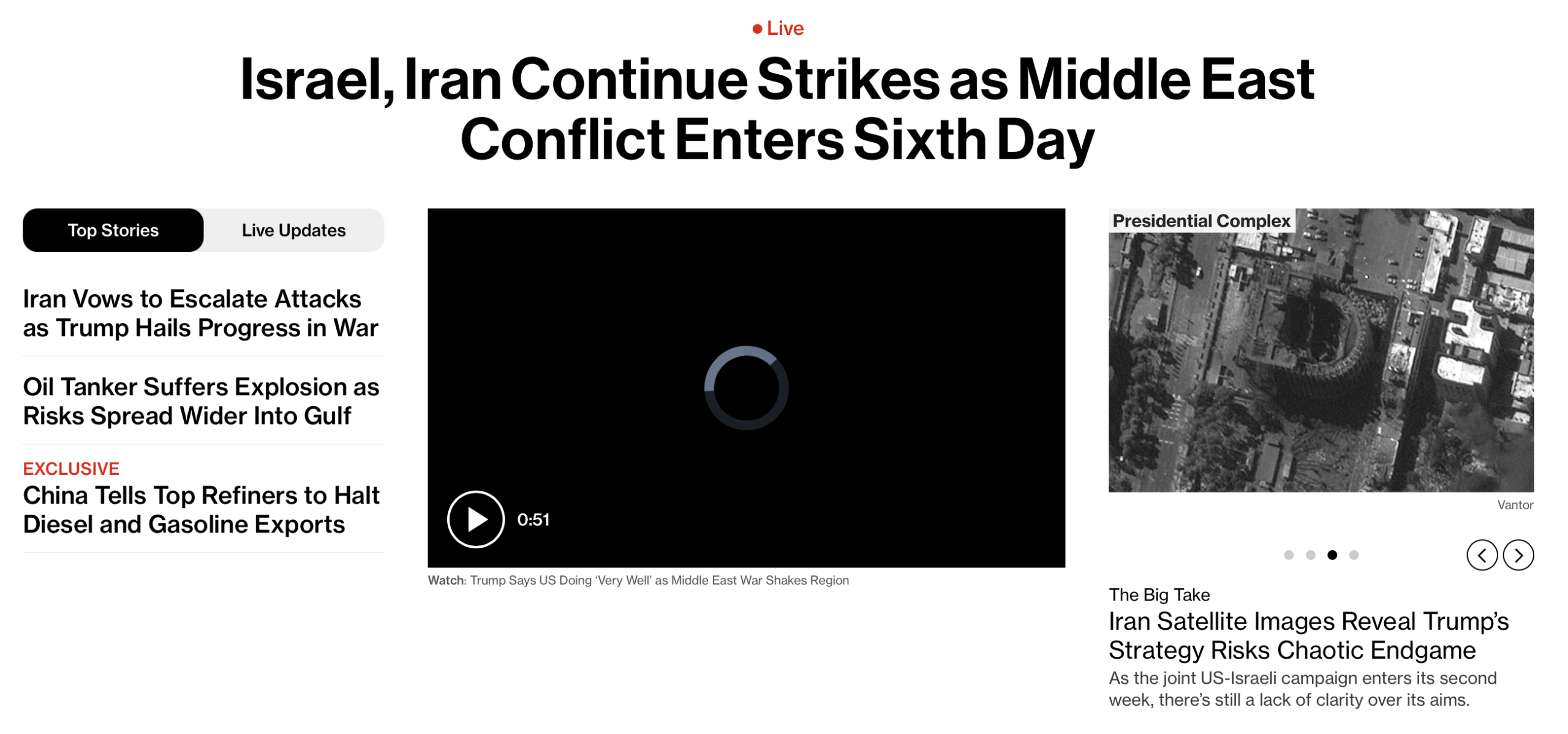
Notice the prominent play that Bloomberg gave to a new tanker incident. From its landing page as of 7:00 AM EST:

From the summary of the oil tanker explosion piece:
• An oil tanker suffered an explosion off the coast of Iraq, damaging a tank that is losing water.
• The Sonangol Namibe was approached by a small boat near Khor Al Zubair in Iraq and its crew later heard a loud bang, according to Sonangol Marine Services.
• The incident marks one of the farthest reaches where vessels have been targeted since the war in the Middle East began, expanding its reach deep into the Persian Gulf.
This will not help insurer nerves.
The last headline on the left, China Tells Top Refiners to Halt Diesel and Gasoline Exports, is not consistent with China having been told by Iran that it will let China-bound ships through the Strait of Hormuz. From that article:
China’s government has told the country’s top oil refiners to suspend exports of diesel and gasoline as an escalating conflict in the Persian Gulf disrupts the arrival of crude from one of the world’s largest producing regions.
While the country is only the third-largest supplier of oil products into the region — its vast refining sector primarily serves domestic demand — China’s curbs just six days into a war reflect a scramble across Asia to prioritize domestic needs as the crisis in the Middle East deepens.
Officials from the National Development and Reform Commission, the country’s top economic planner, called for a temporary suspension of refined product shipments that would begin immediately, according to people familiar with the matter. They asked not to be named as the discussions are not public.
At a meeting earlier this week, refiners were told to stop signing new contracts and to negotiate the cancellation of already-agreed shipments, the people said. An exception was made for jet and bunker fuel held in bonded storage and supplies to Hong Kong and Macau, they added.
Asian nation comes behind South Korea, Singapore
Source: Kpler Ltd.
So we are already seeing an example of how economic shocks from the Strait of Hormuz closure are starting to propagate. Notice in particular that South Korea is an important destination for Chinese fuel exports.
More sobering news on the supply front:
UAE joins Qatar and Saudi Arabia in halting its petroleum production. This is a catastrophe for the world.
That’s 30% of total oil production, 17% of natural gas production.
Worse yet, all the product pipelines are closed. It will take 4 weeks to start back up.
— Korobochka (コロボ) 🇦🇺✝️ (@cirnosad) March 5, 2026
In light of that bleak picture, the balance of our compilation of Iran war developments might seem to be in the “Mrs. Lincoln, how was the play?” category.
In case you have not seen it yet, Larry Wilkerson has a particularly informative discussion with Glenn Diesen:
Must-listen sections include 18:30, where Wilkerson points out that the deemed-essential level for the US Strategic Petroleum Reserve is at about 412 million barrels, when 500 million is the supposed minimum “essential” level. He also says starting at 19:20 that he has it on good authority at 19:20 that Israel has been moving its nuclear weapons and may have uploaded some. He also has a more extended review at 45:45, keying off how Putin might react, how submarines are the most effective type of military weapon and how the Gulf is a great theater for their operations.
But to Wilkerson’s remarks on the headlined topic, of the possible US exploitation of the Kurds (again):
And that’s the first thing I would say about the nature of this conflict, which if you read your Clausewitz, you know the one thing you need to do anytime you’re contemplating using the military axis to turn policy into violence is you need to understand the nature of what you’re entering upon, the nature of the conflict. We do not. Every statement from Marco Rubio, every statement from Peter Hegseth, every statement from Donald Trump, indeed every statement out of the administration to include that bimbo who is the spokesperson for it, that blonde bimbo has indicated to me they do not understand the nature of this conflict. The leading factor of which is we’re taking on a people who are 3,000 years old, 90 million strong, 53% Persian, and who have lots of problems, but who will seal themselves into their very doom in order to give us a truly vicious headache. And that’s what they’re embarked on. And they’re not going to stop. They’re not going to cease until the last one of them is dead. I mean, we can route out all the Kurds we want to try and hire them to fight for us and others like that in the region. And therein lies another disconnect in our understanding of this conflict, the nature of it. The objective of Bibi Netanyahu, for whom we’re fighting this war, is chaos, not putting in tan a regime that would run a reasonably Quisling state or at least a state that got along with the United States and sold us the soil and everything else. He wants chaos, total chaos in the region just like he tried to get in Syria because it’s his plan and people behind him like Naftali Bennett and others to run rampant over the entire Levant from oh ready for this Erdogan from Turkey to Eastern Africa.
After an explanation of how the Iraqi Kurds have reached a modus vivendi with Turkiye and the oil majors and are thus not likely to mix things up in Iran, Wilkerson continues:
And then as far as the Kurds as they overlap in Iran and Syria, I think that’s the d most dangerous group right now because they haven’t gone through this process of learning such as it was that the Kurds in northern Iraq have. So they’re apt to try something just just because it’s arms and they’re free or whatever. But I don’t think they’ll be very successful because I think the Iranians have that sort of thing in mind.
One of the reasons they got the the uh helicopters from Russia, the latest shipment of major end item equipment from Russia was helicopters, attack helicopters. I think the reason they got those was just that they’re the best weapon to use against these border infiltrators, if you will, these armed people that are trying to overthrow the Iranian Republic and coming from places in the in the northern part of the Persian Gulf and on up into the Azerban and Armenia. They’re best killed with helicopters.
So, I think that’s what they got the helicopters for. They anticipated this and they say, “Okay, come on.” That plus SAS. They wanted to take on the British SAS with these helicopters, too, because it warfare has proven over the last decade or so. That’s the best way to use against irregular forces like that that are regular, you know, guerrillas that are actually working for a state. So I think the Iranians have thought this out. I really do. I think they’ve thought it out. No doubt there will be some surprises for them. But of all the contestants in this conflict, they’ve thought it out the longest and the best.
Predictably, the mainstream media is misinforming the public:
Now Fox News is reporting that IRAQI Kurds are launching a ground offensive into Iran.
This is not true, Kurdish Peshmerga from the autonomous Kurdistan Region in Iraq would not launch an offensive into Iran.
Kurdish forces from Iran are based in the Kurdistan Region, and they… pic.twitter.com/48WJ43exbv
— Diliman Abdulkader (@D_abdulkader) March 4, 2026
Additional commentary:
Iranian Kurds’ biggest concern :
The #Kurds do not fear the Iranian regime itself and have fully prepared to free their land. Their real worry is the interference of #Turkey and #Erdogan, and they fear that, like their brothers in #Syria, they may ultimately be abandoned by the… pic.twitter.com/DLV69o8HCD
— Botin Kurdistani (@kurdistannews24) March 5, 2026
And even though there are roughly 10 million Kurds in Iran, as in enough to be able to pose a big problem were they to act in a concerted manner, the fact that the US threw them under the bus in Syria suggests uptake on the latest US offer is not likely to be great:
A month ago, when #Trump turned his back on the Syrian Kurds—the very people who sacrificed thousands of lives to destroy #ISIS —he told them: ‘You’ve been paid; you didn’t work for us for free!’
Afterward, we witnessed how #Kurds were massacred by ISIS terrorists disguised in… pic.twitter.com/VVHpPklU6i
— Ukraine News 🇺🇦 (@Ukrainene) March 3, 2026
Readers have already been debating the US scheme to enlist the Kurds in comments. For example, from yesterday’s post:
elkern
I don’t doubt that we (US/CIA/Israel) would goad/pay Kurds to fight in Iran, but I find it hard to believe that it would be more than a side-show in the larger war. IRGC must have larger and more effective ground forces than anything the Kurds can put up, and any such conflict would be limited to the mountains of NW Iran. US/Israeli air power might be able to kill a bunch of IRGC there, but not enough to enable the Kurds to attack Teheran or other targets deeper into Iran.
OTOH, “chaos” would be considered a complete success by Israel, because it would end Iran’s ability to support Hezbollah, Hamas, etc. (See: Iraq, Syria, Libya, etc).
And in reply:
Polar Socialist
IRGC must have larger and more effective ground forces than anything the Kurds can put up […]
It’s a bit complicated, but yeah, IRGC is about 150,000 strong, with around 600,000 Basij-militia volunteers available immediately (and some 24 million in reserves).
Meanwhile, Artesh, the actual Iranian army responsible for fighting invasion*, is a conscript army with a strength of some 500,000, half of which are conscripts** with an immediate stand-off reserve of about 750,000 men and a bigger second echelon reserve of about 5,000,000 men.
* as far as I understand, IRGC is more focused on internal security and foreign interventions, whereas Artesh is responsible for the national defense. So, IRGC special units would enter Iraq to fight the CIA-Kurds there, Artesh would meet the CIA-Kurds on the border and the Basij would secure the Iranian Kurdish regions. IRGC actually has a battalion of Kurds in it’s ranks, and it also does a lot of social work in the Kurdish regions.
** 18 months of service if one is positioned in an “insecure” region and gets fired at, 24 months otherwise. Meaning at least a fraction of Iranian conscripts and reservists have combat experience.
Now very briefly to the Israeli attack on Lebanon and resultant pounding by Hezbollah:
Israel tells people in large parts of southern Lebanon to leave ahead of attacks BBC
Hezbollah leader vows to fight on as Israel expands operations in Lebanon France24
But at Lebanese civilian in the south are suffering, Hezbollah is hitting Israel harder than expected. So much for the idea that the assassination of Hassan Nasrallah and the pager attack put an end to Hezbollah as a fighting force. Please click through on these tweets:
JUST IN: 161 rocket alerts just fired across central Israel simultaneously.
5.9 million people reached for shelter at 2:26 in the morning.
Iran launched ballistic missiles at Tel Aviv today. Hezbollah sent drones from the north at the same time. The combined barrage was a… pic.twitter.com/HpliIGjV5q
— Shanaka Anslem Perera ⚡ (@shanaka86) March 5, 2026
Israel has warned all citizens from densely inhabitants in Burj al-Barajneh, Bharat Hreik, Shiyah , Harat-Hreyk, and Hadath in Beirut the capital to evacuate immediately. The reasons?
reduce civilian presence before strikes
• allow heavier bombardment of targeted structures
•… pic.twitter.com/duVzkZ1ovo
— Elijah J. Magnier 🇪🇺 (@ejmalrai) March 5, 2026
Hezbollah has published an image of a destroyed Merkava tank
The Lebanese Islamic Resistance Movement has destroyed six Merkava tanks of the occupiers since yesterday. pic.twitter.com/9nqCfWQ63a
— Sprinter Press (@SprinterPress) March 4, 2026
Hezbollah leader Naim Qassem has pledged to continue the group’s fight against Israel, which continues to bomb Lebanon and occupy positions in the south of the country. Qassem rejected the Lebanese government’s plans to disarm the group. pic.twitter.com/wocl5iPgIe
— Al Jazeera Breaking News (@AJENews) March 5, 2026
Hebrew media reports that Israel is preparing for a scenario in which rocket fire from Iran and Hezbollah could escalate, with Yemen potentially joining in.
— The Cradle (@TheCradleMedia) March 5, 2026
Also consider generally:
“Israel” has become an information blackout zone, an isolation chamber where we’re forced to rely entirely on second-hand reports of explosions, since people are getting arrested for sharing footage of missile strikes.
It must be going far worse for them than they’re letting on
— Cedar Salvo 🇱🇧🇵🇸 (@cedarsalvo) March 5, 2026
We would be remiss if we failed to point out that Iran is on the receiving end of a lot of ordnance. A quick recap on the Iran end from Middle East Eye:

Further updates will be in comments.